
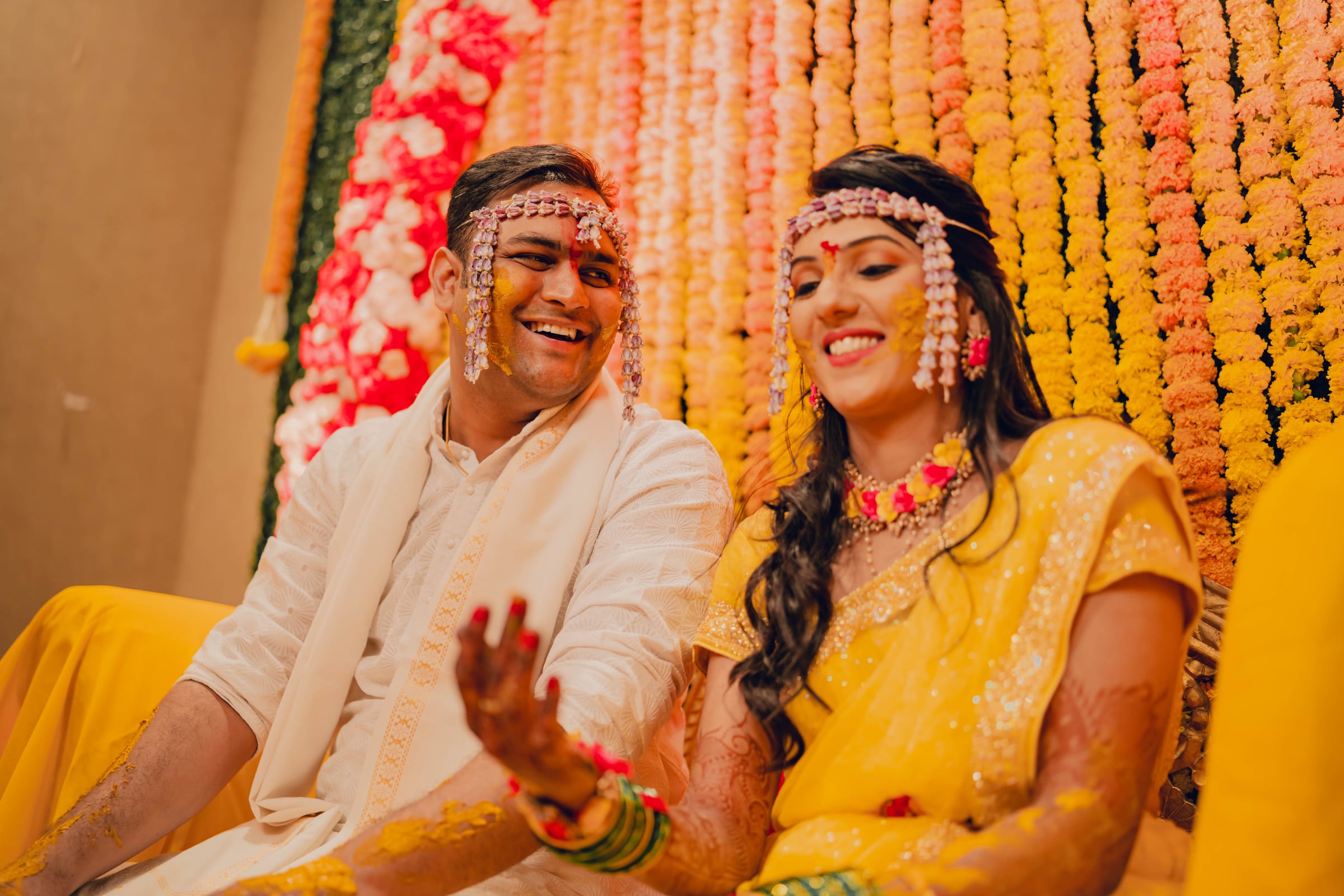
There is a reason photographers secretly love the haldi. You cannot pose it. The moment the first fistful of turmeric hits someone's cheek, all the stiffness of the day falls away and you get real faces: shrieking, laughing, ducking, smearing it on each other with the specific glee of people who no longer care how they look. For a candid photographer, that is the whole job made easy and made hard at the same time. Easy because the emotion is right there. Hard because it happens fast, it is messy, and it will destroy a camera that is not protected.
If you are booking a photographer for your haldi, or wondering whether the ceremony even needs its own coverage, this is what actually goes into shooting one well, and why it is a better test of a candid photographer than the wedding itself.
Why the haldi exposes a photographer's real skill
At a posed studio's hands, a wedding ceremony can be stage managed. The couple can be positioned, the light controlled, the shots more or less arranged. The haldi resists all of that. Nobody is going to hold a pose while turmeric drips down their face. The photographer either sees the moment and catches it, or misses it. There is no second take.
So if you want to know whether a photographer is genuinely candid or just uses the word, look at their haldi frames. This is the exact test we describe in our guide to candid wedding photography in Mumbai: could this photo have happened if the photographer were not there? At a haldi, the honest answer is always yes, which means every good frame is proof of a photographer who can actually see and react.
What makes the haldi so photogenic
The colour. Turmeric yellow against skin, against a white or yellow outfit, against marigold. It is one of the most saturated, joyful colour palettes in the entire wedding, and it photographs beautifully.
The light. Haldis are often held in the morning or afternoon, frequently outdoors or on a terrace, which means natural light. Good light plus real emotion is the candid photographer's dream.
The chaos. No stage, no fixed positions, no formal timeline. Just people moving, laughing, and covering each other in paste. Chaos is where documentary photography thrives.
The faces. This is the moment the family lets go. The uncle who was serious all morning is suddenly the loudest. The bride is laughing with her mouth open, not smiling for a camera. These are the frames couples end up loving most.
We have shot haldis across communities, and they are almost always the set of images couples flag first when the gallery lands, precisely because nobody remembers them being taken.
How a good photographer actually shoots a haldi
They protect the gear and get close anyway. Turmeric and water are murder on cameras. A photographer who knows haldis brings rain covers or a dedicated body they are willing to risk, so they can get into the mess instead of shooting it nervously from ten feet back. The best haldi frames are taken from inside the action.
They shoot wide and tight. Wide to hold the whole joyful scene, tight to catch the single drop of turmeric mid air or the expression on one face. A ceremony this fast needs both, which is an argument for at least two shooters.
They watch the edges. The main action is obvious. The gold is often at the edges: the grandmother laughing at the whole thing from her chair, the child who got caught in the crossfire, the quiet smear between the couple away from the crowd.
They use the light, not a flash. A flash at a bright morning haldi flattens everything and announces the photographer. Available light keeps the colour and the mood intact.
Does the haldi really need dedicated coverage?
Couples sometimes treat the haldi as a warm up and give it minimal attention, then regret it. The haldi is frequently the most relaxed, most genuinely happy event of the entire wedding, precisely because there is no stage and no pressure. Skimping on it means skimping on the most candid, most joyful photos you will get.
It does not necessarily need a huge team. But it needs a photographer who is present, protected, and ready to get into the mess, not one saving themselves for the main ceremony. If you are booking full wedding coverage, make sure the haldi is genuinely included and not treated as an afterthought. Our main guide to hiring a wedding photographer in Mumbai covers how to check what is actually in your package.
The haldi and your community's traditions
The haldi shows up across most Indian weddings, and it carries the flavour of the community around it. A Maharashtrian haldi has its own warmth and rhythm, which we touch on in our Maharashtrian wedding photography guide. Whatever the community, the core stays the same: turmeric, family, and the moment everyone finally relaxes.
Should you film the haldi too?
The haldi has a soundtrack: the laughter, the teasing, the music, the shrieks when the cold paste lands. A photograph freezes the colour but loses the sound. If you are already considering a wedding film, the haldi is one of the most fun, most watchable segments of the whole edit, which we get into in our guide to cinematic wedding films in Mumbai.
A short checklist before you book
- Ask to see a full haldi gallery, not one or two frames. You want to see they covered the whole ceremony.
- Check the frames are close and inside the action, not distant and careful.
- Look for real, open mouthed laughter and messy faces, not tidy smiles.
- Confirm the haldi is properly included in your coverage, with enough time allotted.
- Ask how they protect their gear, a small question that quietly tells you they have shot many haldis.
The haldi is where the wedding stops performing and starts being itself. Photograph it right and it gives you the truest, happiest images of the whole celebration.
See how we shoot it across our wedding stories, and when you are ready, tell us about your day.
FAQ
Does the haldi need a separate photographer?
Not separate, but it does need real attention within your coverage. It is often the most candid and joyful event of the wedding, so make sure it is properly included and not rushed.
Why do photographers use a longer lens or old camera at haldis?
Turmeric and water damage equipment. Experienced haldi shooters bring protection or a body they are willing to risk, so they can get close to the action instead of shooting it cautiously from a distance.
Is a haldi better for candid or posed photos?
Candid, without question. It is nearly impossible to pose a haldi, which is exactly why it produces such genuine images. It is one of the best tests of whether a photographer is truly documentary.
Should we do the haldi indoors or outdoors for better photos?
Outdoor or well lit spaces give you natural light, which suits the ceremony beautifully. If it has to be indoors, make sure the space is bright, and hire someone comfortable working in low light just in case.